- Talent rows open at 0, 5, 10, 15, 20, 30, 40, 50 and 60 points spent. Saved points do not open a row until they are allocated.
- The 10-, 30- and 60-spent rows contain exclusive capstones. Reaching a threshold opens the row; taking its capstone still consumes a point.
- Wikily reports a full reset fee of 4s(s+1) gold and a one-point refund or capstone swap fee of 8s, where s is the number currently spent. Check the displayed in-game confirmation before paying.
The nine row thresholds and what they mean
| Row | Spent threshold | At least this many total points to buy its first point | Choice rule |
|---|---|---|---|
| 1 | 0 | 1 | Compare ordinary talents and their rank limits |
| 2 | 5 | 6 | Compare ordinary talents and their rank limits |
| 3 | 10 | 11 | One capstone in this row |
| 4 | 15 | 16 | Compare ordinary talents and their rank limits |
| 5 | 20 | 21 | Compare ordinary talents and their rank limits |
| 6 | 30 | 31 | One capstone in this row |
| 7 | 40 | 41 | Compare ordinary talents and their rank limits |
| 8 | 50 | 51 | Compare ordinary talents and their rank limits |
| 9 | 60 | 61 | One capstone in this row |
Evidence: Wikily — talent rows and gold refunds
The third column is editorial arithmetic: with ten total points, spending all ten opens the 10-spent row but leaves no point to buy a capstone. With eleven available, you can spend ten to reach it and spend the eleventh there. The same distinction applies at thirty and sixty. A route described as “the level-60 capstone” can mean the row’s label rather than a legal allocation at exactly sixty total points. Count the purchases before following a level-by-level guide.
Evidence: Wikily — talent rows and gold refunds
A row gate counts investment in the tree. It does not require every earlier talent to be maxed. Concentrating the first five points is a simple way to reach the second row, but the useful target is five spent points with effects that serve the present build. At later stages, continuing to fill an early node can delay a named mechanic below it. Conversely, rushing downward with irrelevant points can create a legal tree that does not clear your current map.
Build a route around an actual combat requirement
Name the attack family
Record the slotted Basic, Strong and two Specials. Decide whether the immediate shortage is damage, mana, recovery or a missing target condition.
Choose the enabling talent
Read which ability, tag or enemy status the talent names. A Strong Attack modifier does not necessarily help your Basic anchor.
Count the route to its row
Add points required before the gate, then the enabling talent itself. Include any visible dependency and maximum-rank limit.
Choose one capstone per gate
Write an explicit choice for each reached capstone row. Do not add the effects of two alternatives from the same row.
Spend the remaining budget deliberately
Compare each next rank with the new options opened below. Reassess after the desired mechanic works rather than maxing everything by habit.
Evidence: Wikily — talent rows and gold refunds
The captured reference gives one Combat Talent point per hero level, reaching seventy at level seventy. Those points are a hard build budget. Equipment, runes and Life Skills can support the same attack, but they do not turn a seventy-point tree into a larger Combat Talent allocation. A planner can help add effects; inspect its class, level and point total before transferring the plan to the game.
Evidence: Wikily — talent rows and gold refunds · AFK Meta — Warrior talent planner
Examples: a bonus can create a new shortage
| Talent | Row gate / max ranks | Reported effect at max | Decision to make |
|---|---|---|---|
| Focused Technique | 10 spent / 1 | +100% Basic Attack damage with reduced Basic mana gain | Useful Basic emphasis can make a Strong/Special loop harder to sustain. |
| Enhance Strong Attack: Mana | 15 spent / 5 | 25% Strong Attack mana-cost reduction | A cost fix is targeted to Strong attacks; it is not every spell’s reduction. |
| Rage Infusion | 50 spent / 10 | +150% Strong Attack damage, +100% mana cost | Inspect mana after taking the damage; a red, unaffordable ability loses casting opportunities. |
| Hold the Line | 5 spent / 5 | 15% less damage with at least three living enemies nearby | Pack defense is conditional and may not cover a lone boss. |
| Second Wind | 50 spent / 5 | Heal 50% when HP falls below 50%; six-second cooldown | A recovery trigger has timing limits; it does not erase every burst hit. |
Evidence: AFK Meta — Warrior talent planner
These examples show why “take every damage node” is not a complete route. The point that opens a tier may have an immediate effect, a resource cost or a condition. Match that condition to the encounter you are farming. Keep a record of the current tree before replacing it, especially when a build depends on several named talents that an abbreviated guide omits.
Evidence: AFK Meta — Warrior talent planner
Reset, refund or swap: calculate the right cost
| Spent s | Full reset 4s(s+1) | One point / capstone 8s |
|---|---|---|
| 5 | 120 | 40 |
| 10 | 440 | 80 |
| 30 | 3,720 | 240 |
| 50 | 10,200 | 400 |
| 60 | 14,640 | 480 |
| 70 | 19,880 | 560 |
Evidence: Wikily — talent rows and gold refunds
A full reset and a small edit have different jobs. At fifty spent points, moving an eligible single point is reported as 400 gold; resetting everything is 10,200. If you refund three independent points consecutively without reallocating between them, the model charges 8×50 + 8×49 + 8×48 = 1,176 gold. If you refund and re-spend each time, the spent count returns to fifty and each later refund may again cost 400. The example is a calculation over the source model, not a price observed in a current client.
Evidence: Wikily — talent rows and gold refunds
Capstone replacement is described as left-clicking another choice in the same row, moving the chosen point for the single-point fee. That does not mean you can activate both capstones. For a substantial family change, calculate the old-to-new route and its dependency order first; several apparently cheap edits can be inconvenient if later tiers keep earlier points locked.
Evidence: Wikily — talent rows and gold refunds
Why “Other talents depend on this point” appears
Wikily reports that right-click refunds can be refused when a later invested row would no longer have enough points before it. Suppose a later row needs thirty earlier points and you are exactly on that boundary. Removing one of those prerequisite points can invalidate the later purchase. A refund blocked by this rule is not evidence that the point cannot ever be moved; remove the dependent later investment or use a deliberate full reset if the game offers it.
Evidence: Wikily — talent rows and gold refunds
| Symptom | Check | Useful next action |
|---|---|---|
| Hero has enough level but the row is locked | Unspent versus spent points | Allocate useful prerequisite points before buying the new row. |
| Row opens but its talent cannot be bought | Whether a point remains in the budget | Count the threshold plus the purchase itself. |
| Refund is refused | Invested later rows at the boundary | Rework dependencies from later purchases toward earlier ones. |
| Two capstone effects are in the written plan | Whether they occupy the same row | Choose one and remove the other effect from the comparison. |
| Damage rises but the main ability stops casting | Mana cost, ability family and cooldown | Treat sustain as part of the rebuilt tree. |
Evidence: Wikily — talent rows and gold refunds · AFK Meta — Warrior talent planner
A rebuild checklist and common questions
Save the allocation
Record class, hero level, total spent and unspent points, capstones and the four active abilities.
Price the intended edit
Use a one-point or capstone price for a local change and the full-reset model for a new route. Compare the actual confirmation.
Protect the farming budget
Do not spend the gold needed for an immediate potion upgrade or recovery unlock merely to test an unproven talent variation.
Rebuild and verify the gates
Check point totals, one capstone per tier and the named skill prerequisites before closing the panel.
Measure the effect on the same activity
Compare clear time, mana gaps and deaths with unchanged equipment and recovery settings. Keep the old allocation as the baseline.
Evidence: Wikily — talent rows and gold refunds
Q: Does spending a new point cost gold?
The captured talent reference says normal allocation is free. Refunds, capstone moves and full resets have their own gold fees.
Q: Should I always put my first five points into one talent?
Five spent points open the next row. Concentration is a practical starter suggestion; choose a talent that answers your present class and combat need.
Q: Can I take every capstone at the level cap?
No. The row choices are exclusive, and the total Combat Talent budget remains limited. Read the row and point total together.
Q: Does a planner’s Start over button perform a game reset?
A web planner edits a plan. Its controls do not establish what has happened in the game or which gold confirmation the client will show.
Evidence: Wikily — talent rows and gold refunds · AFK Meta — Warrior talent planner
Official interface reference
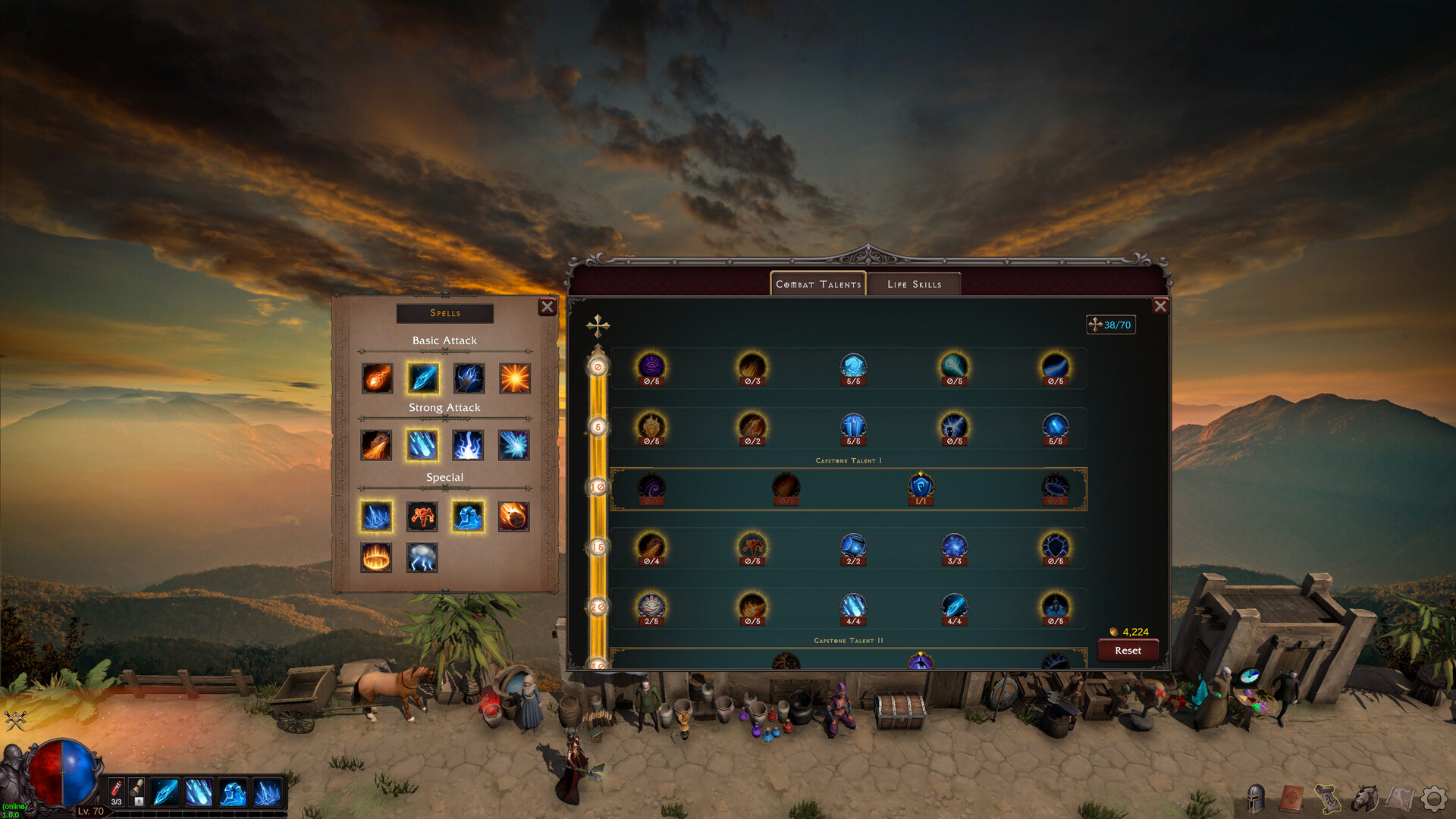
Sources and scope
Source-reviewed guide for Deskrawl: Idle ARPG, Steam app 4623570. Named mechanics and figures are attributed to retained community references or dated official patch announcements. The editorial pass reread the cited source bodies and recorded excerpts and hashes. Publisher independence is not established for community data mirrors. No installed-client test, measured best build, or live game-version confirmation has been performed.
- Review status
- verified
- Game version
- Community snapshots collected 2026-10-04/05; official 1.0.0h and 1.0.0i are used only for their announced changes.
- Checked
- Method
- Bounded first-release dossier review, including source roles, preserved conflicts and explicit limits. Recomputed retained source hashes, exact excerpts and line ranges and signed reader content. No installed-client or live-server verification.
- Wikily — talent rows and gold refunds community
Community-reported points-spent thresholds, exclusive capstones, level-based point budget, refund dependencies and respec formula.
Checked
- AFK Meta — Warrior talent planner community
Data labeled 3 October 2026; row requirements, maximum ranks and named Warrior talent tradeoffs. Its interface is a planner, not proof of current in-game controls.
Checked
- Wikily — ability slots and automatic casting community
Community-reported four-slot order, mana and cooldown requirements, Basic versus Strong/Special timing, and target restrictions.
Checked
- Official Steam retail promotional screenshots first-party
The attributed promotional figure only; capture date and client build are not established, and it is not a current gameplay test.
Checked